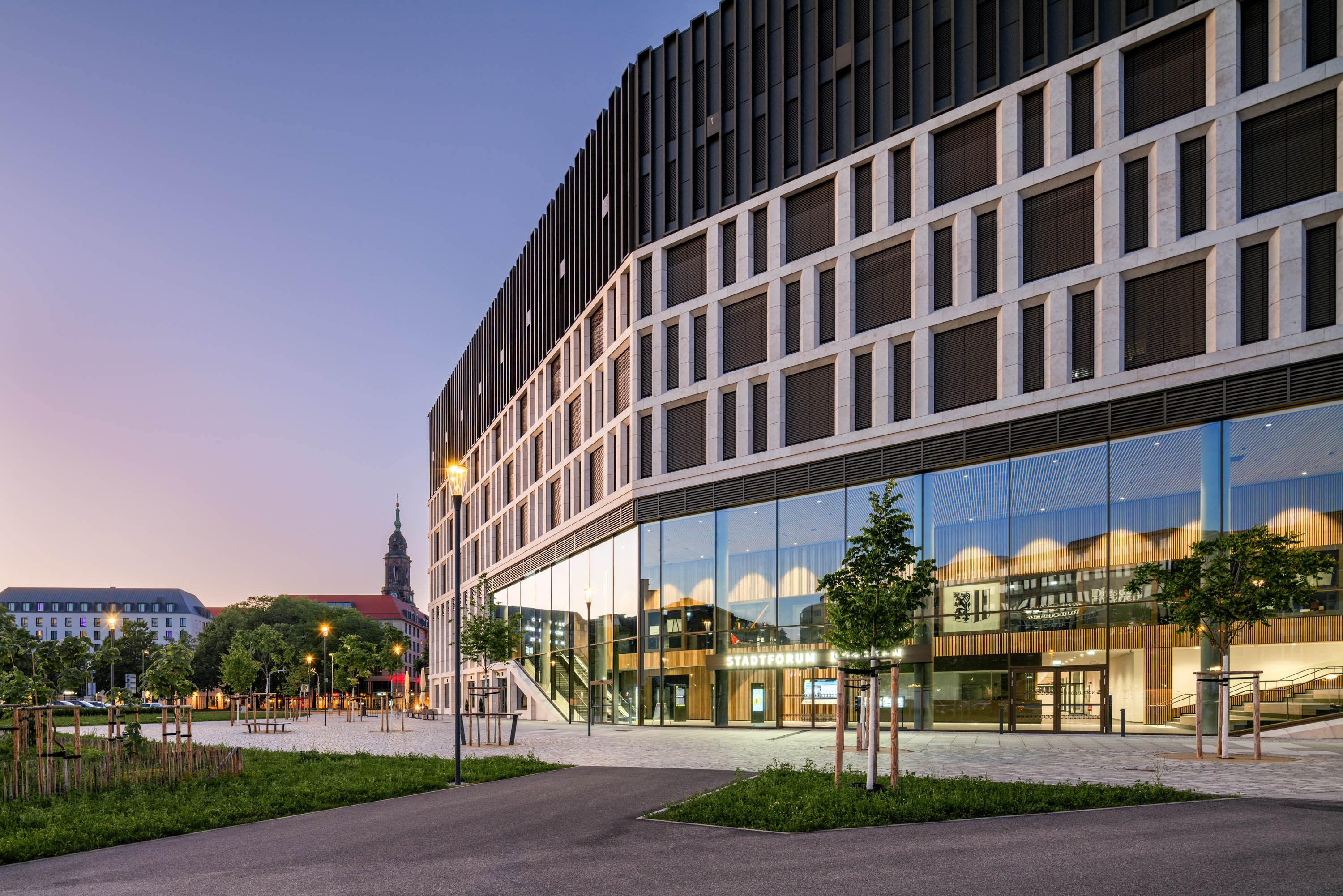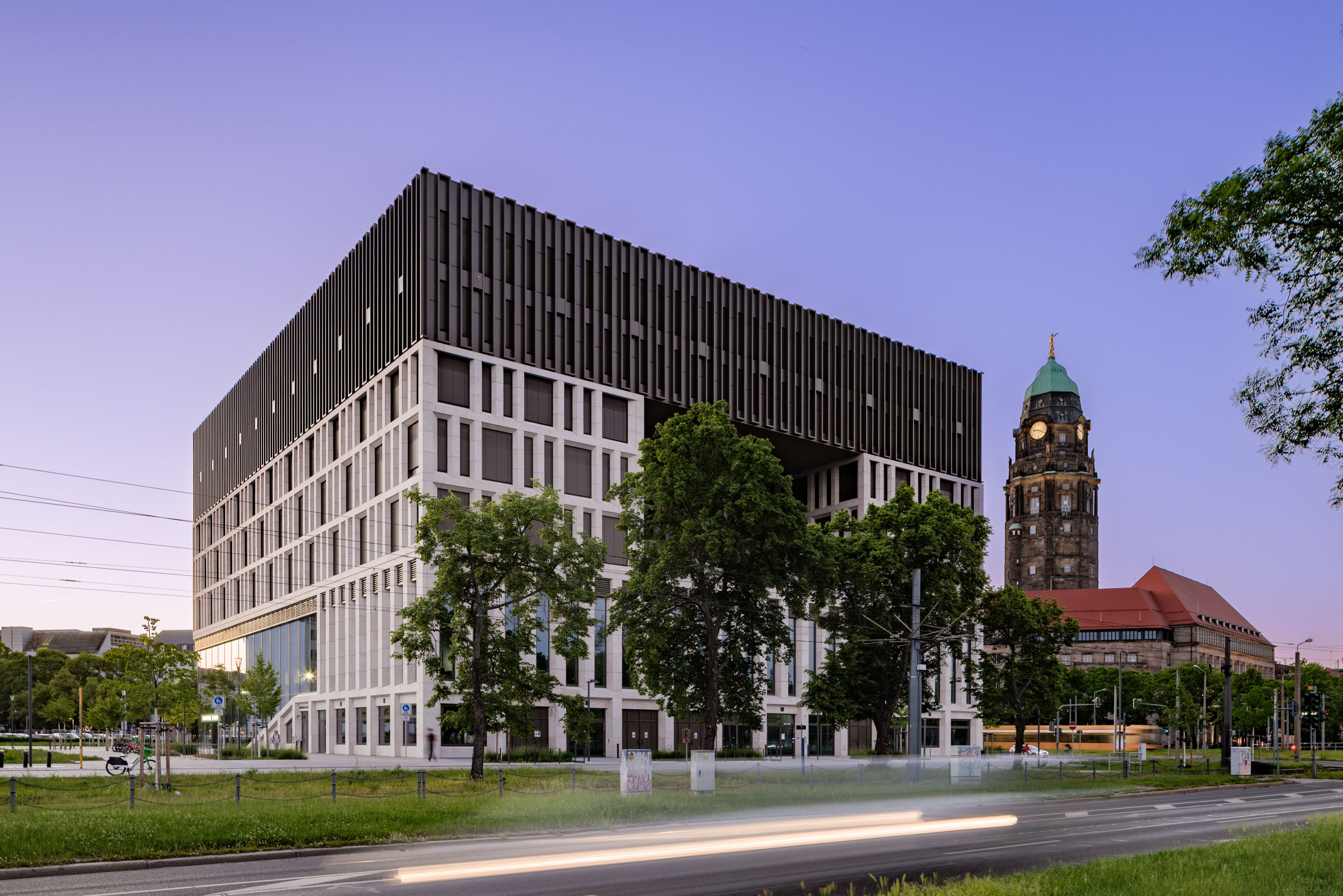
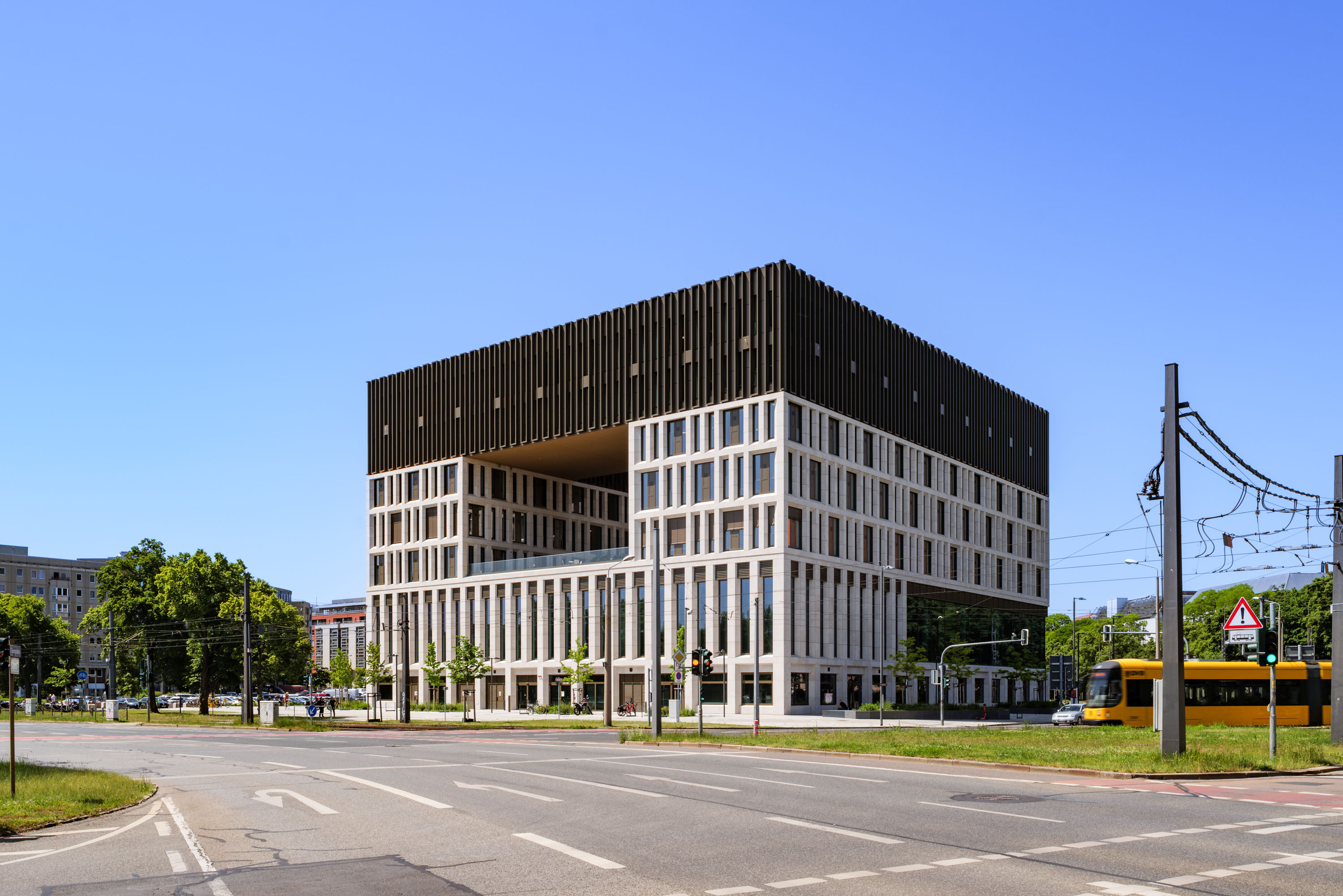
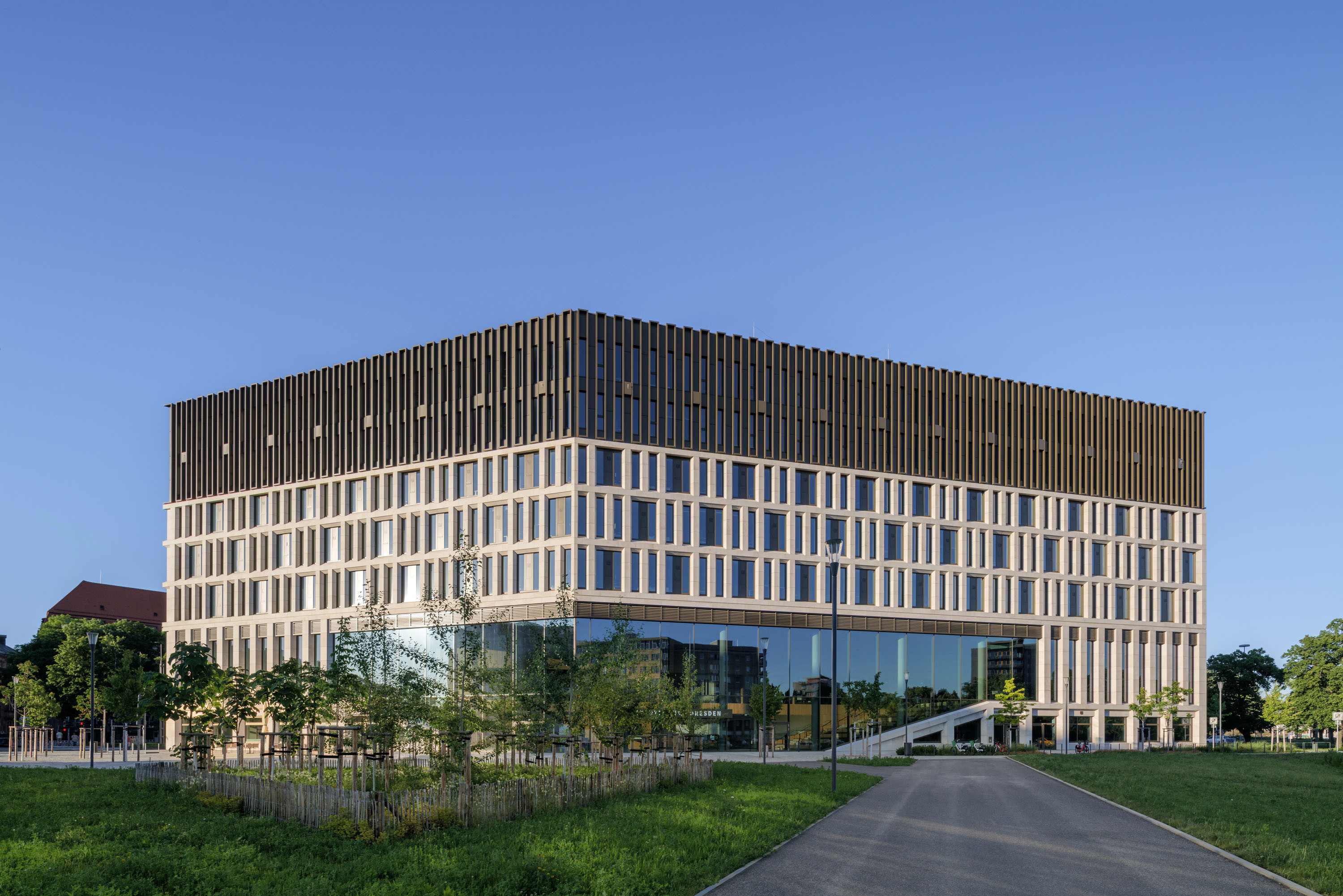
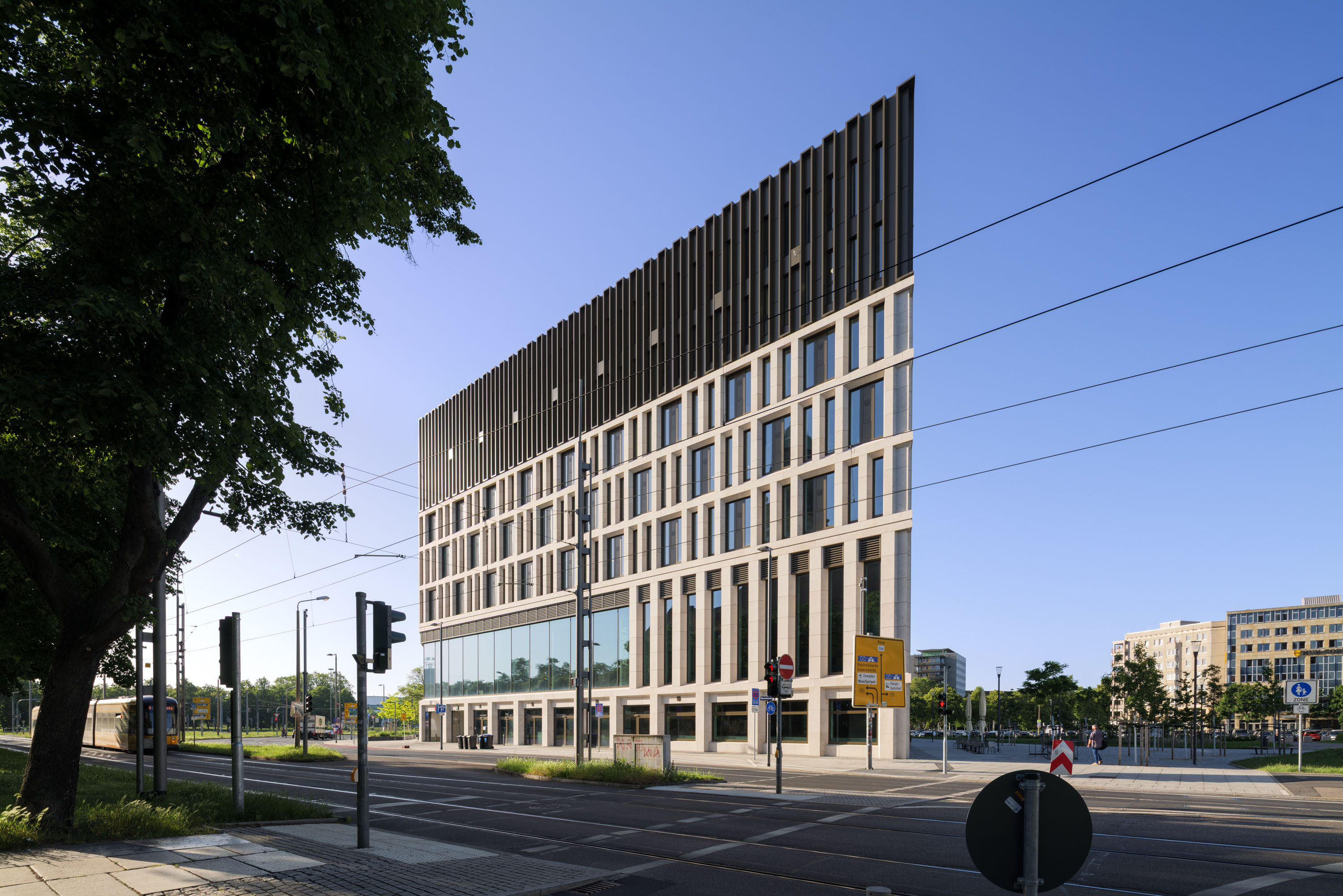
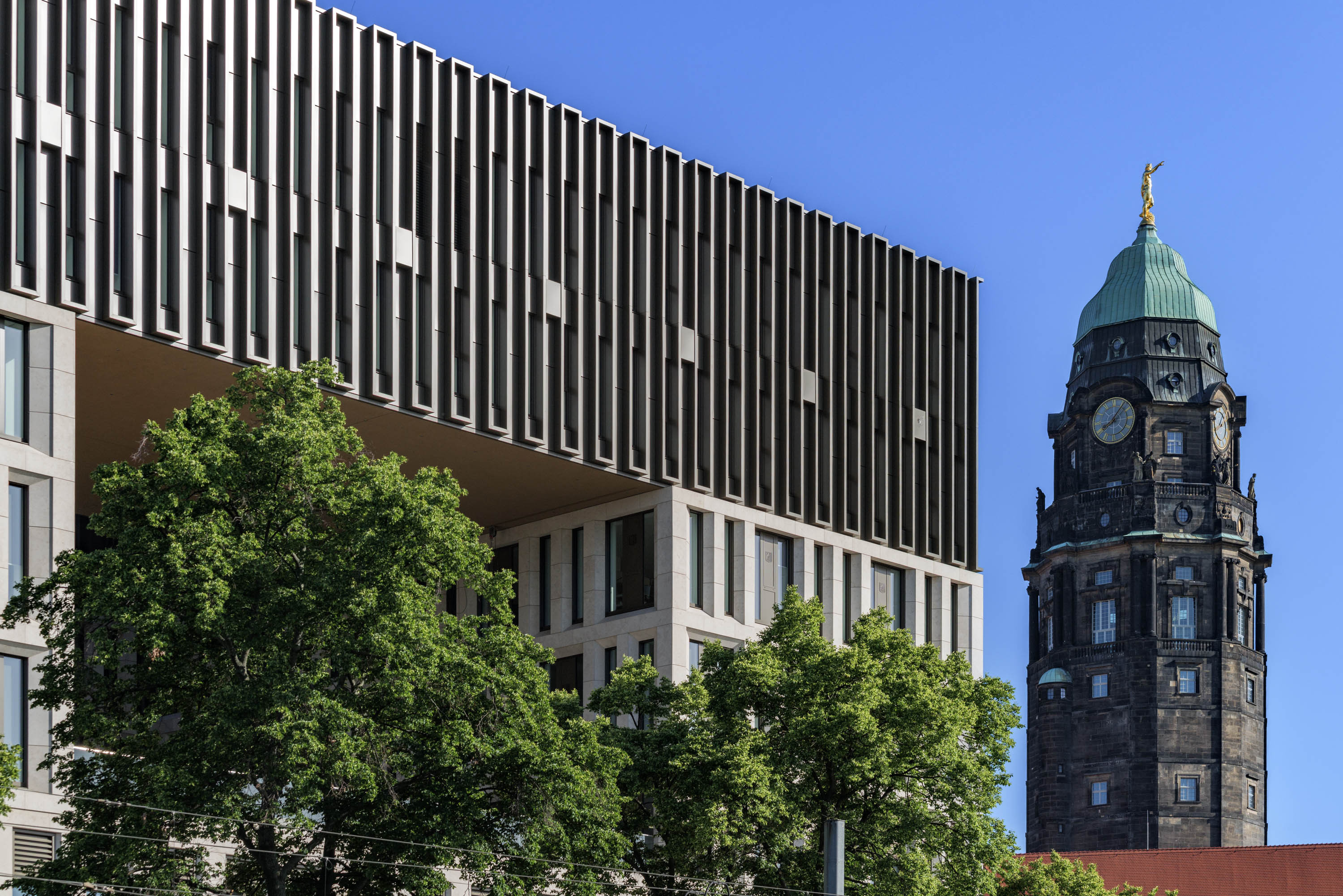
Situated opposite the historical city hall and leading in the direction of very extensive areas of greenery and transport to the east, the new building marks the edge of Dresden’s old city centre.
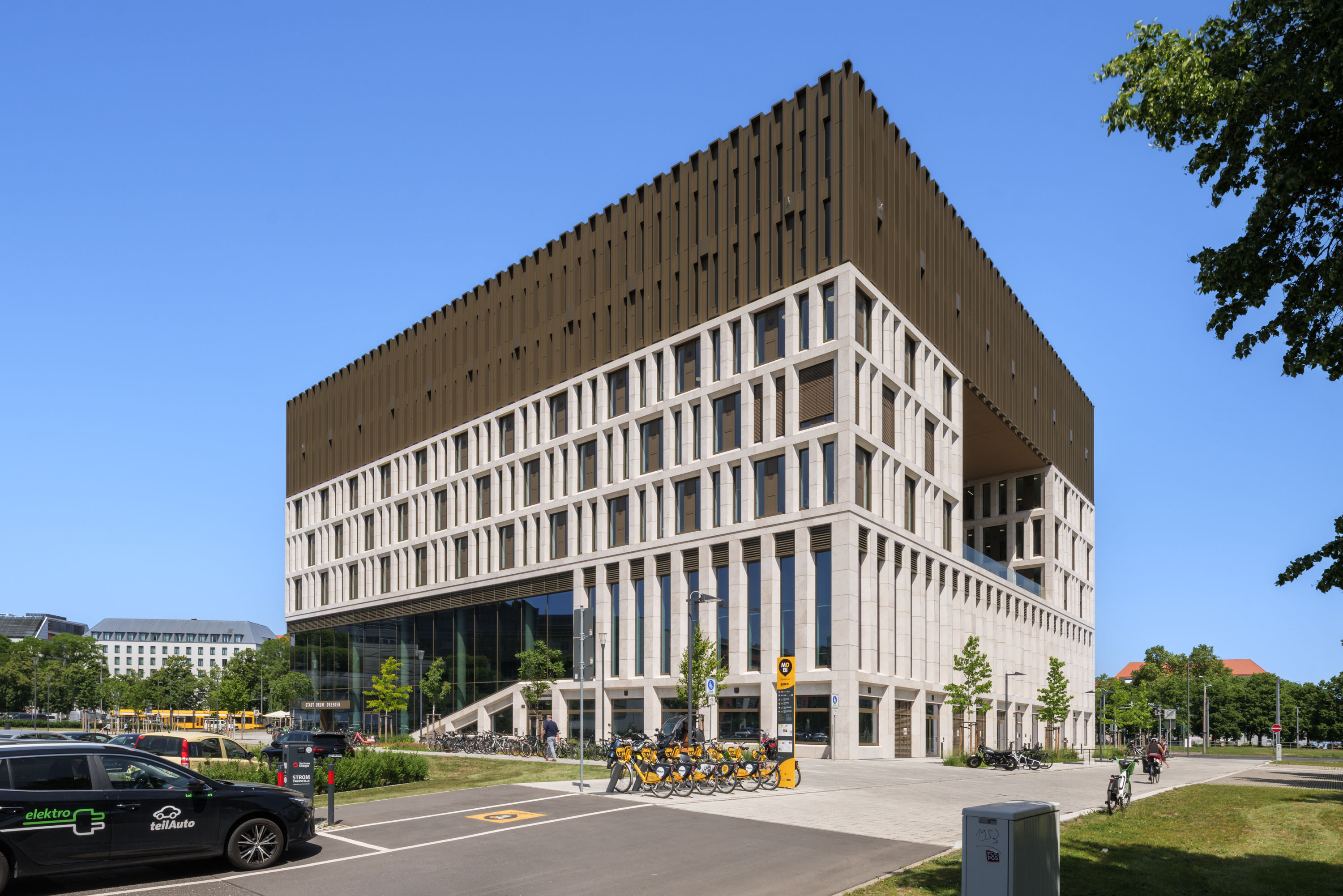
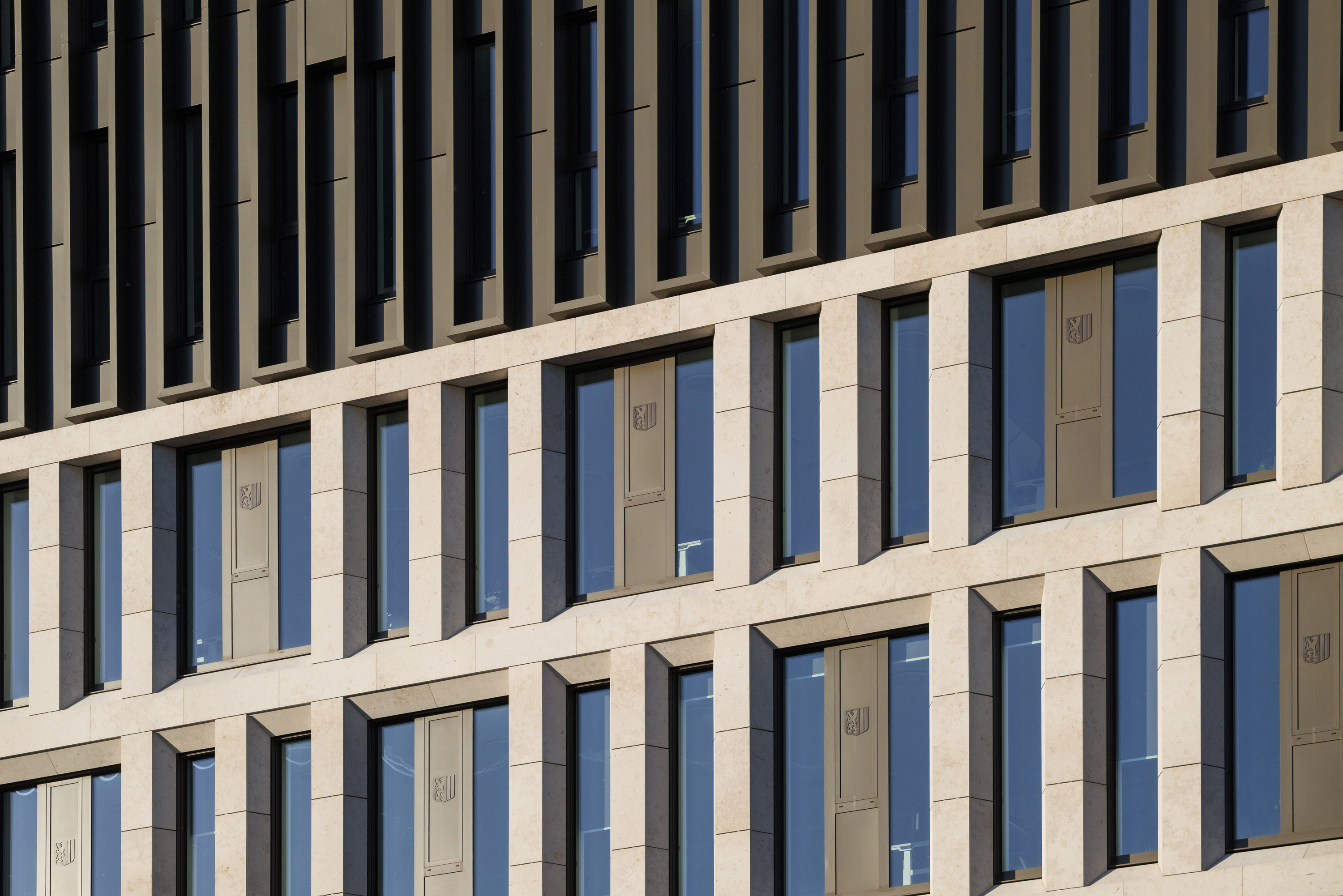
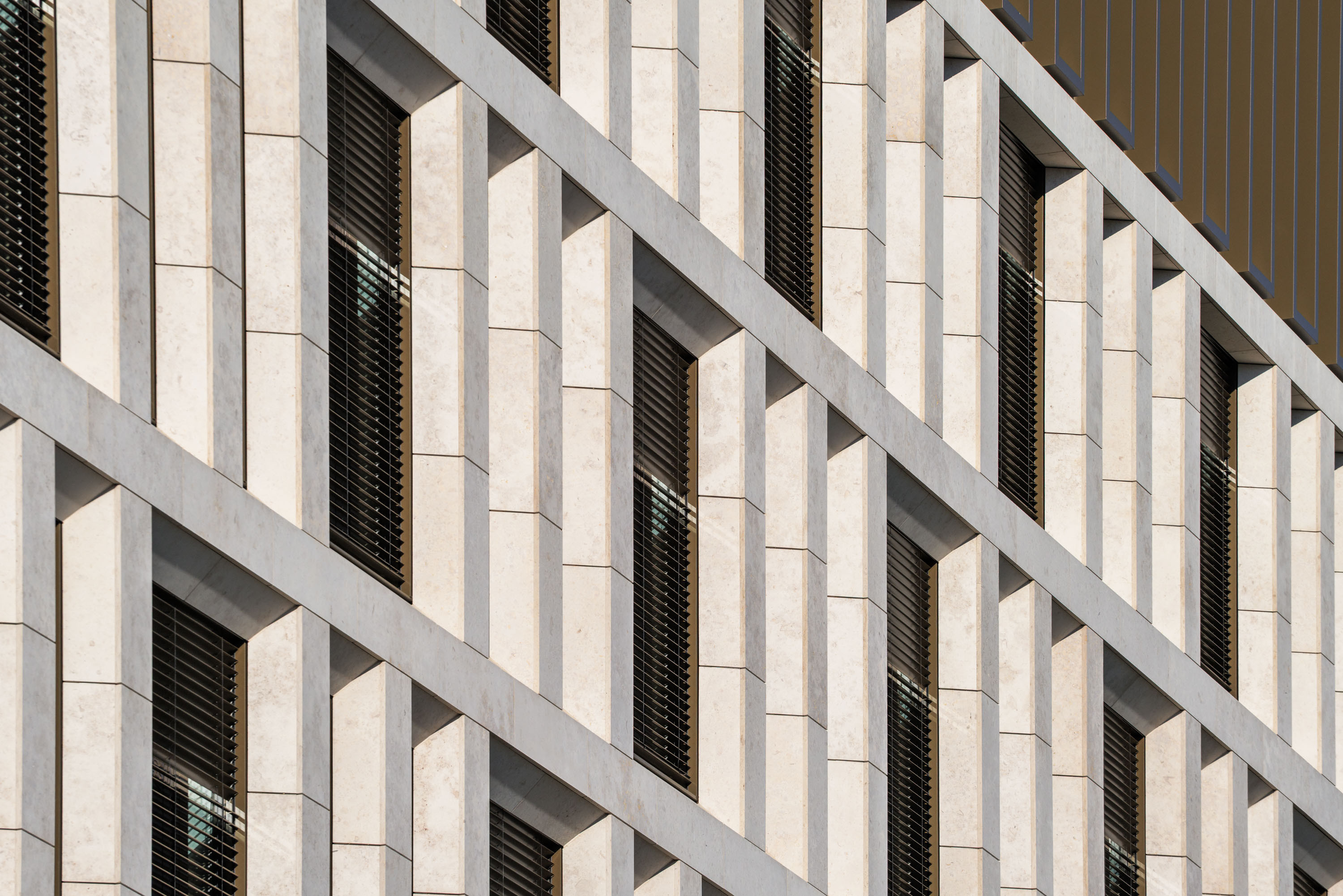
The entire facade is impressive for its plasticity: the resulting play of shadow on the light-beige Dietfurt limestone is especially effective on the building’s base and middle parts. The graphically homogeneous coloration of the material was chosen in reference to the sandstone facades of the surrounding principal buildings. Above the area of natural stone with its diagonally arranged reveal panels, the fifth and sixth floors are distinguished by an orthogonally oriented metallic façade in which alternating glazed and non-glazed panels are framed by bronze-brown coated aluminium pilaster strips.
On both the ground floor and the central section, the city coat of arms is depicted as a sculpted relief on natural stone lintels and window shutters. These emphasise the variation in the façade’s rhythm, signify the building’s public function and are in keeping with Dresden’s tradition of richly decorated façades on public buildings.
A façade opening with glazing spanning two storeys marks the building’s main entrance at its south side on Ferdinandplatz. A panoramic window on the first floor on the north façade has a view of the city hall opposite. The planted inner courtyard has an opening from the second to the fourth floors, making a connection with the green spaces south of the city centre.
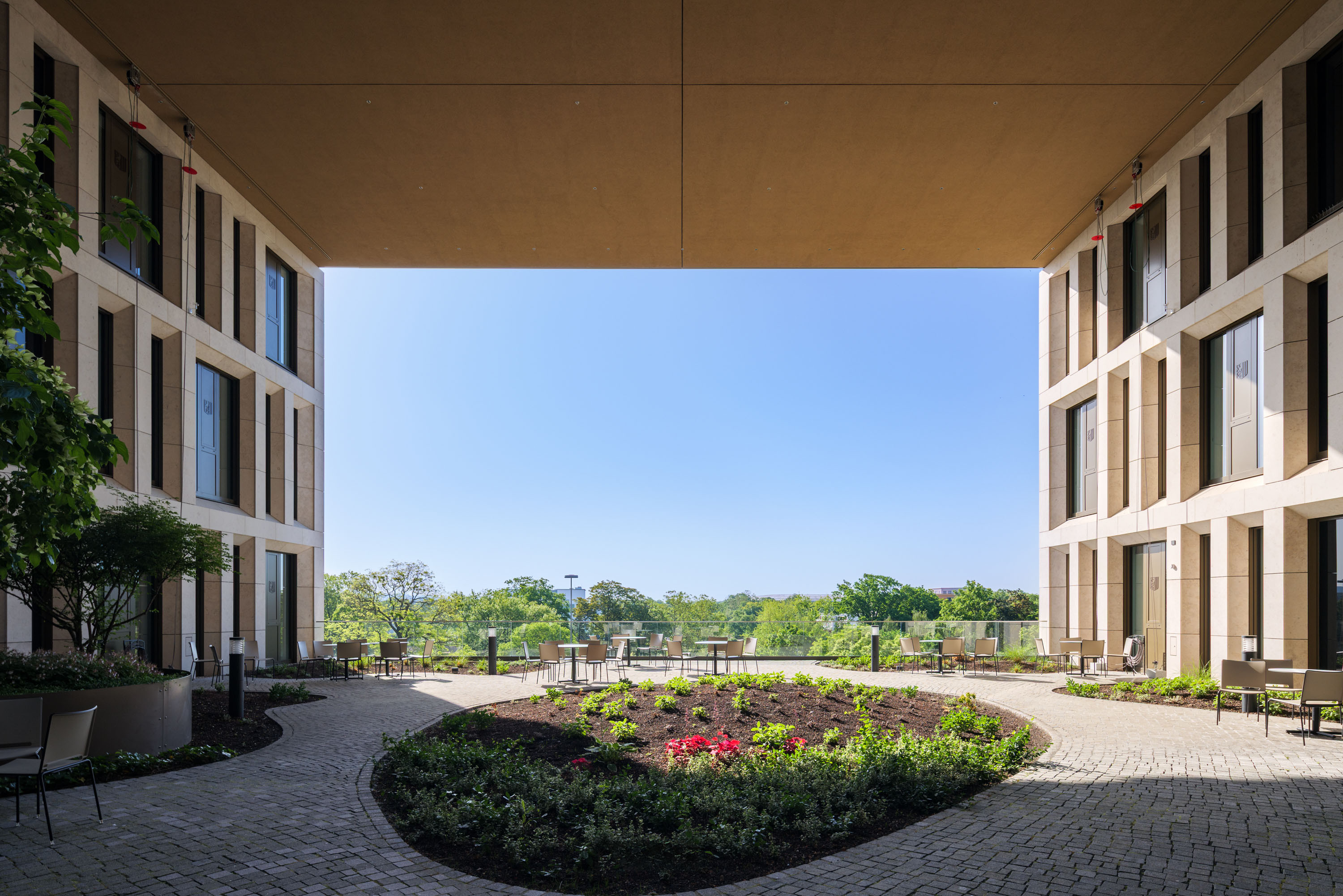
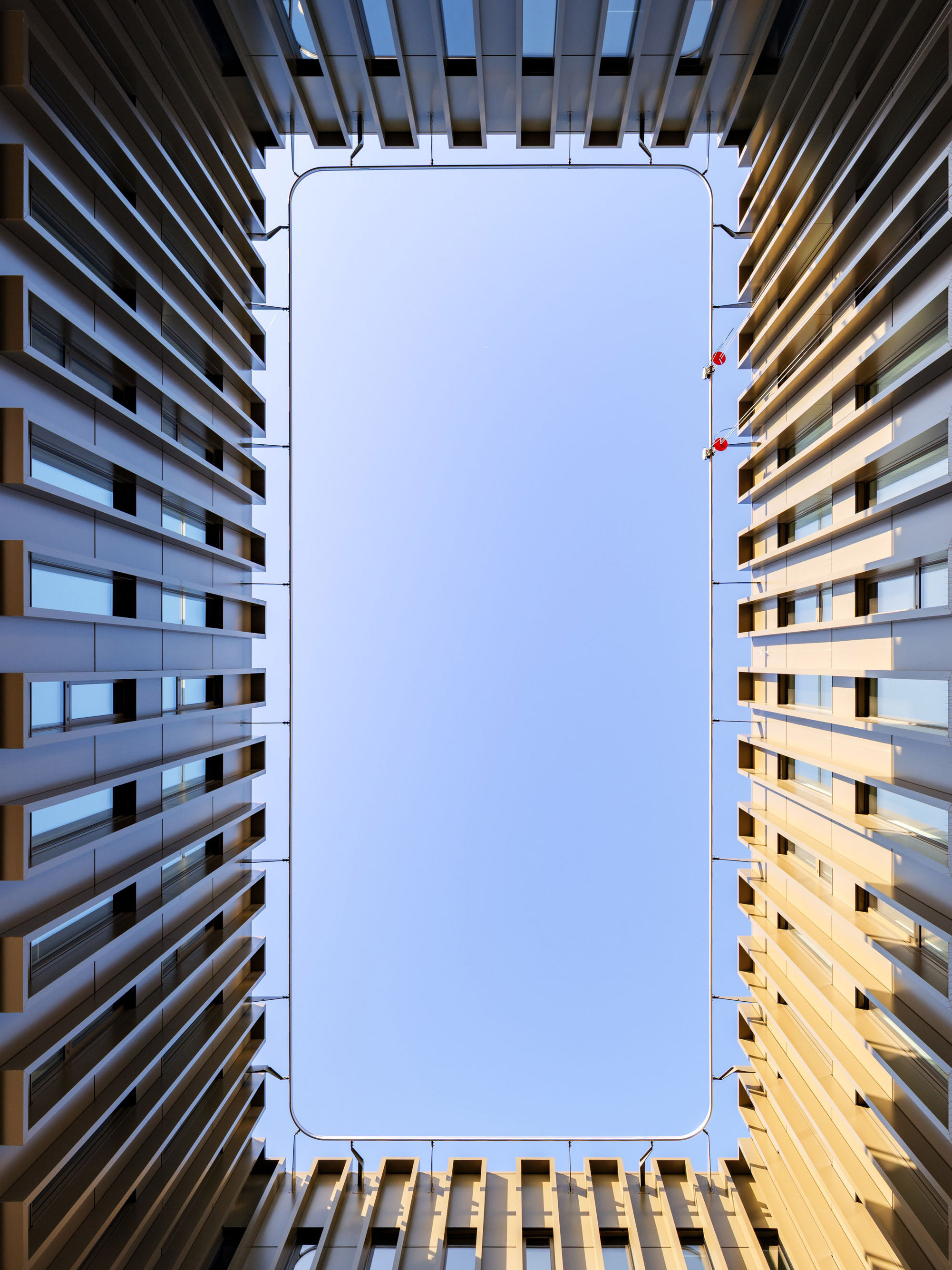
Five office floors above are for purely business uses and are organized around two green inner courtyards, which provide natural light and a pleasant working environment.

The green roof, which incorporates 376 photovoltaic modules oriented east-west, delays the flow of rainfall into the underground infiltration trenches, benefitting microclimate and drainage.

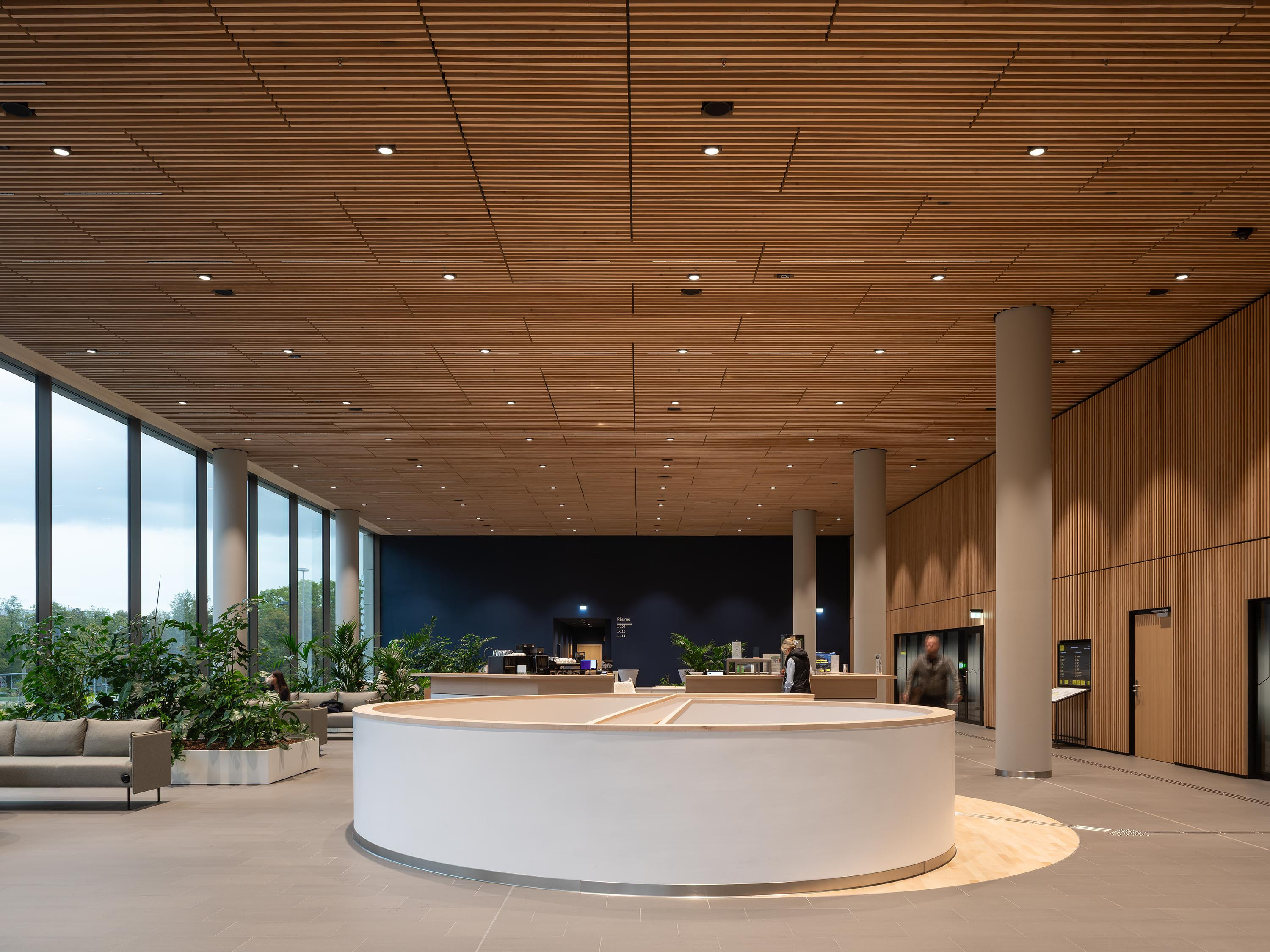
The ground floor contains publicly accessible areas including a foyer with an information desk, a restaurant, the city’s lost-and-found office, and rooms where citizens can receive advice. The foyer areas with their individual bronze-coloured elements and homogeneous grey flooring pick up on the materiality of the façade and outside amenities. This space takes its character from the silver-fur slats covering the walls.


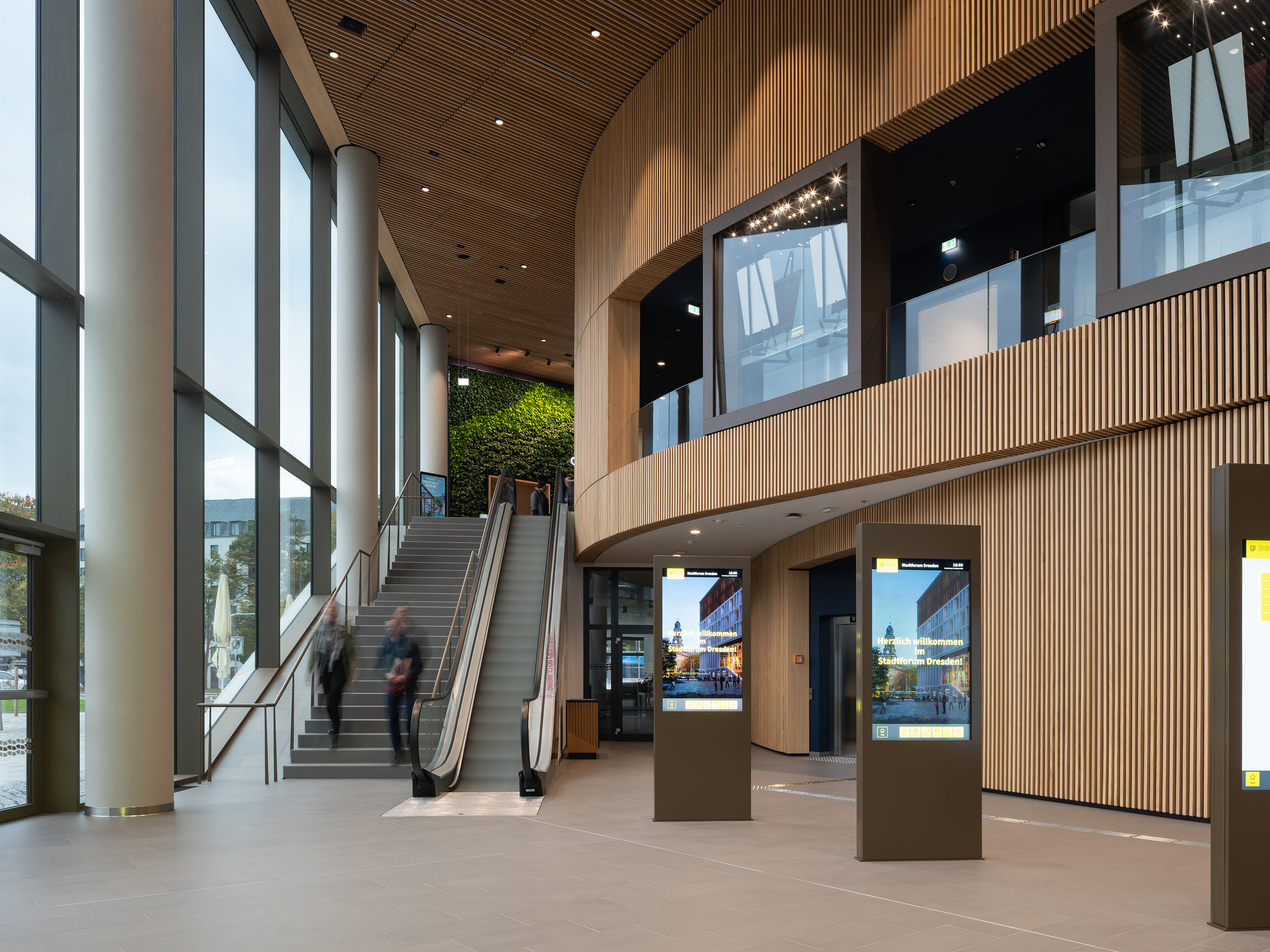
The passage leading from the foyer to the Agora and the tip of the building contains a 100-sqm planted wall stretching the full height of this space. This has an automatic watering system.
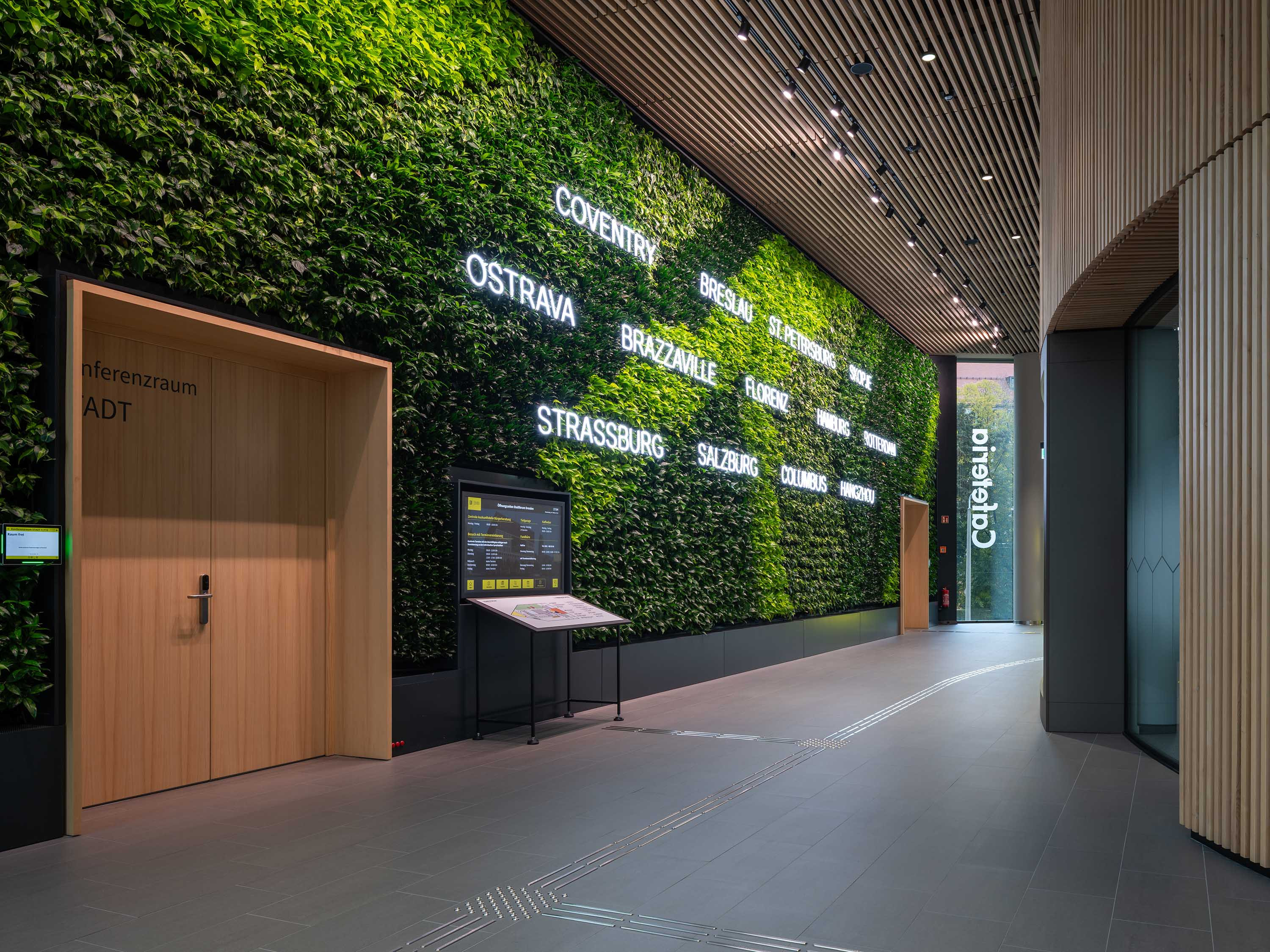
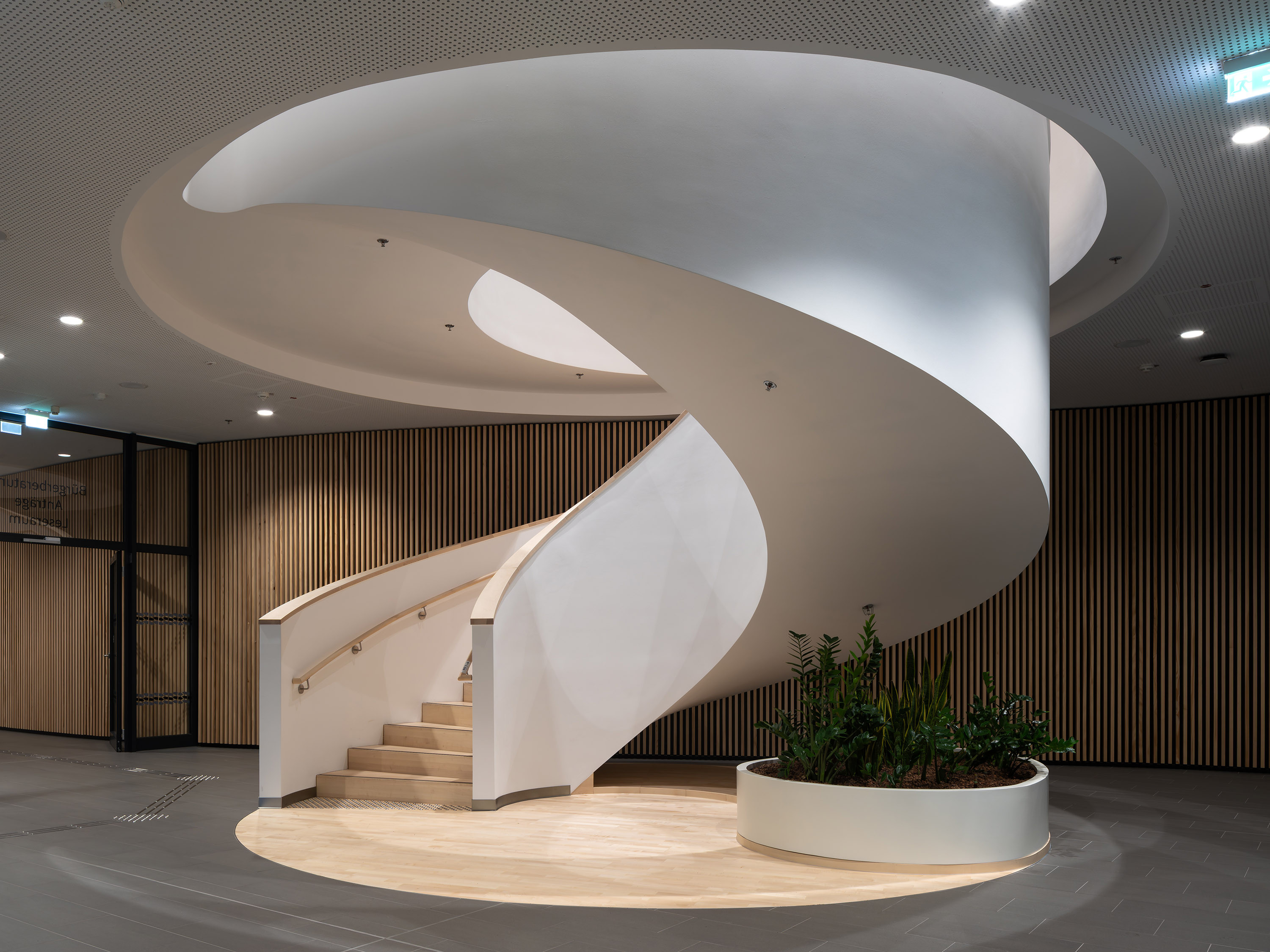
The public and semi-public uses of the two first floors are interwoven in a ring shape by open and spiral sets of steps, forming an informal recreation area – the ‘Agora’ – with additional café, lounge, and exhibition spaces.

The building meets Germany’s KfW-55 energy standard and received the BNB Silver sustainability certificate.